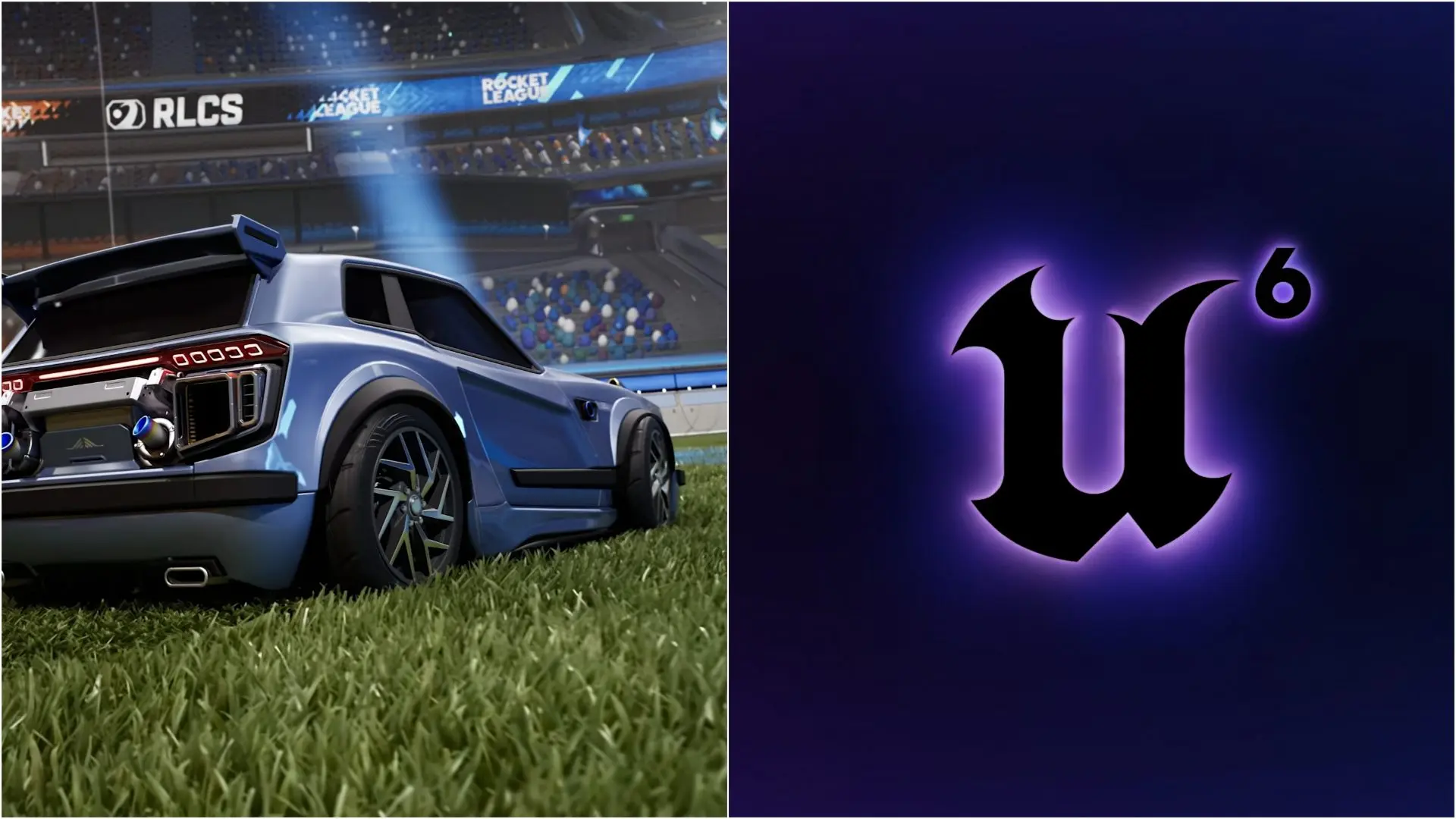

Epic Games officially unveiled Unreal Engine 6 at the Rocket League Championship Series Paris Major 2026, giving the first public look at the next-generation game engine from the developer. Epic surprised fans by choosing Rocket League instead of a traditional tech demo to show off the new engine's capabilities.
The brief teaser trailer showed a graphically upgraded version of Rocket League with much better lighting, reflections, textures and stadium environments. Cars looked vastly more detailed with boost effects and environmental lighting that seemed more lively than in the current version of the game.
The reveal also confirmed Rocket League will jump directly from Unreal Engine 3 to Unreal Engine 6, skipping the previously rumored move to Unreal Engine 5 altogether. Fans had long expected the game to migrate to UE5 after years of speculation surrounding an engine upgrade for the aging title.
Rocket League originally launched in 2015 using Unreal Engine 3, making it one of the oldest major live-service games still operating on that technology. Many players and developers viewed the engine transition as increasingly necessary because the existing technology limits graphical improvements, customization systems, and broader technical upgrades.
Epic Games did not provide a release date for Unreal Engine 6 or the upgraded version of Rocket League. The company also avoided revealing detailed technical specifications during the Paris event. However, Wccftech reported that preview versions of UE6 could potentially arrive sooner than expected, possibly as early as next year.
The announcement immediately triggered major discussion throughout the gaming industry because Unreal Engine remains one of the world’s most important game development platforms. Unreal Engine 5 already powers many major modern titles, and the reveal of UE6 raised questions about how quickly developers may transition to the next generation of Epic’s technology stack.
This teaser, therefore, proved to be one of the biggest gaming technology announcements of 2026 and kicked off Epic Games’ next big platform transition for players and developers alike.
Rocket League Becomes the First Major Unreal Engine 6 Showcase
Rocket League emerged as the centerpiece of Epic Games’ Unreal Engine 6 reveal, positioning the game as one of the first major showcases for the company’s future engine technology. The Paris Major teaser highlighted upgraded stadium visuals, enhanced physics presentation, better reflections, and more advanced environmental detail running on the new engine.
Fans reacted strongly because Rocket League’s aging Unreal Engine 3 foundation has been a frequent criticism within the community for years. Discussions on Reddit immediately focused on excitement about the modernization but also raised concerns about whether gameplay physics could change during the engine migration.
Other members pointed out that Rocket League’s precise physics and movement systems are core to the game’s competitive identity. Players repeatedly warned that even small changes to car handling or ball movement could dramatically affect professional play and esports competition.
Epic and Psyonix described the transition as the beginning of a “new era” for Rocket League. The teaser hinted at broader improvements involving customization systems, visuals, and connected ecosystem features tied to Epic’s larger platform ambitions.
The news also came during the RLCS Paris Major, underscoring the continued significance of Rocket League to Epic’s esports ambitions. The Rocket League Championship Series is among Epic’s largest competitive gaming ecosystems, and the company recently renewed its partnerships around Rocket League and Fortnite esports through 2028.
Analysts said that Rocket League makes a good technical showcase because its fast-paced gameplay makes visual improvements and performance upgrades more visible. Improved lighting, reflections and smooth animation can significantly boost the experience for players and the presentation for esports broadcasts.
Some gaming commentators also speculated that Unreal Engine 6 could become associated with next-generation gaming hardware in the same way Unreal Engine 5 became linked with the PlayStation 5 during its early demonstrations. Push Square described the teaser as potentially offering “the first glimpse of PS6-era visuals.”
The Rocket League reveal therefore served not only as a game upgrade announcement but also as Epic Games’ first major public demonstration of how Unreal Engine 6 may shape the future of gaming technology and live-service ecosystems.
Epic Games Pushes Toward a Connected Metaverse Ecosystem
The Unreal Engine 6 teaser also reflected Epic Games’ broader strategy of building a more interconnected gaming ecosystem linking Fortnite, Rocket League, creator tools, and user-generated experiences. The trailer briefly referenced Fortnite, LEGO Fortnite, UEFN, and other Epic platforms tied to its expanding metaverse ambitions.
Epic Games CEO Tim Sweeney previously discussed plans to merge traditional Unreal Engine development with the creator-focused Unreal Editor for Fortnite, commonly known as UEFN. The Unreal Engine 6 announcement reinforced expectations that Epic wants future games and user-created experiences to exist within the same technological ecosystem.
Industry analysts have noted that Epic increasingly views Fortnite as more than a battle royale game. The platform already includes concerts, creator-made experiences, racing games and esports events, making it central to Epic’s long-term strategy for digital entertainment and social interaction.
Epic is in the middle of a big restructuring of its larger gaming ecosystem and the announcement of Unreal Engine 6 comes in that context. Earlier in 2026, several Fortnite-connected projects, including Rocket Racing and Fortnite Ballistic, were cancelled or scaled back due to poor engagement. Epic appears to be more and more interested in consolidating experiences into larger, interconnected platforms rather than supporting stand-alone projects.
Epic also continues to expand creator tools via UEFN, allowing players and developers to create custom games and experiences directly inside Fortnite’s infrastructure. Analysts believe Unreal Engine 6 could further unify professional development tools with creator-driven content systems.
The gaming industry closely watched the announcement because Unreal Engine powers a massive portion of modern game development worldwide. Future versions of Fortnite, Rocket League, and creator-made experiences may all become interconnected through shared systems, assets, and online infrastructure.
At the same time, Epic provided very few technical details about Unreal Engine 6 itself. The company has not yet confirmed performance targets, hardware requirements, AI integration features, or developer timelines.
Still, the Rocket League reveal strongly suggested that Epic Games views Unreal Engine 6 not simply as a graphics upgrade, but as the foundation for a much larger connected gaming and creator ecosystem spanning esports, user-generated content, and live-service entertainment.