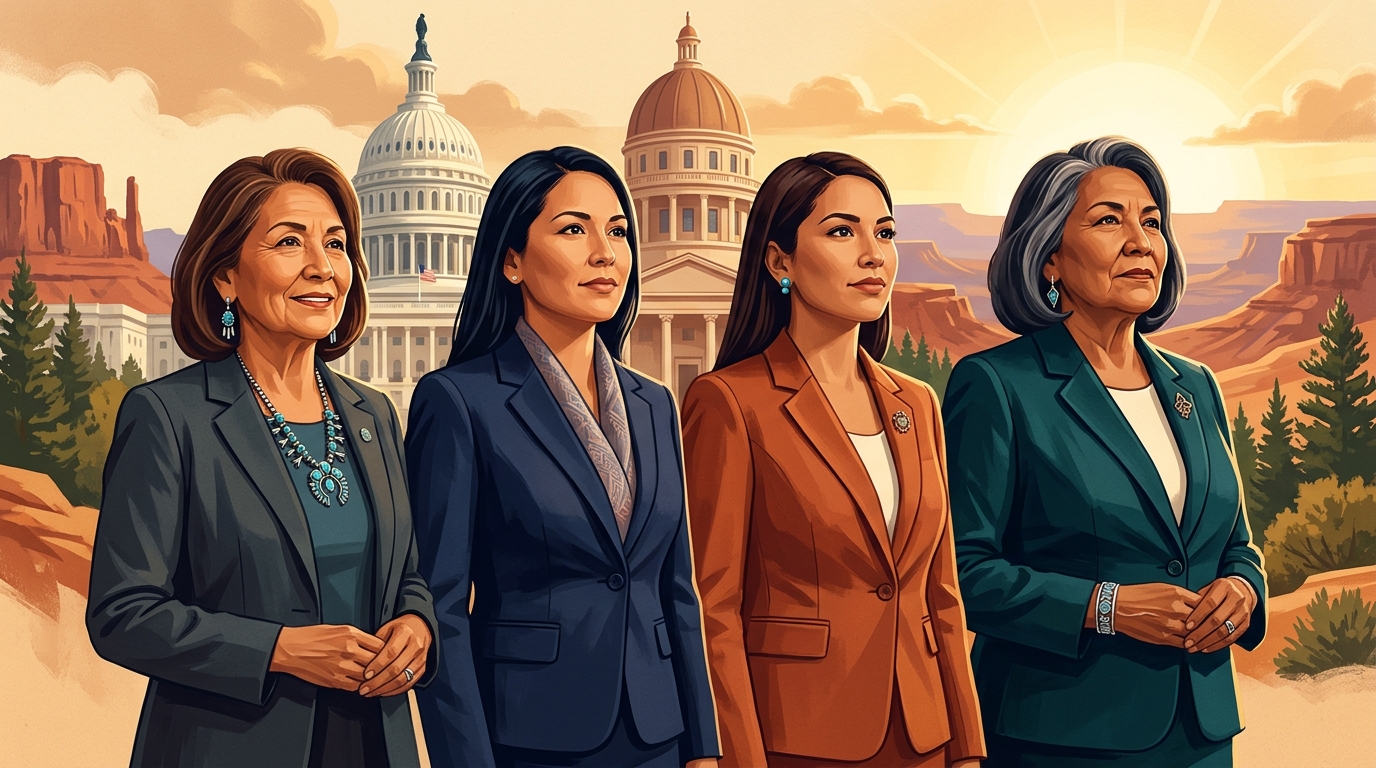
Native American women achieved a historic sweep across tribal, state and federal elections in November 2026, breaking centuries-old barriers to executive and legislative power in a single election cycle.
Voters in Minnesota elected Lieutenant Governor Peggy Flanagan as the first Native American woman to serve in the United States Senate, while New Mexico voters chose former Interior Secretary Deb Haaland as the first Native American woman governor in U.S. history. At the sovereign tribal level, Crystalyne Curley won the presidency of the Navajo Nation and Tina Abrams captured the presidency of the Seneca Nation of Indians—each becoming the first woman to hold her nation’s top executive office.
According to nationwide tracking by Advance Native Political Leadership and ICT, at least 75 Native women, nonbinary, and Two-Spirit candidates won races across local, state, federal, and tribal ballots this cycle. Political analysts and civic leaders described the results as a generational realignment that translates decades of community organizing into formal governing authority.
Peggy Flanagan Breaks the U.S. Senate Barrier in Minnesota
In Minnesota, Democratic-Farmer-Labor candidate Peggy Flanagan defeated Republican opponent Michele Tafoya to claim an open U.S. Senate seat, becoming the first Indigenous woman elected to the upper chamber of Congress since its founding in 1789.
Flanagan, an enrolled citizen of the White Earth Band of Ojibwe, built her statewide coalition after serving two terms as Minnesota’s lieutenant governor alongside Governor Tim Walz. Before entering statewide executive office, she trained Native candidates and community organizers through Wellstone Action and served in the Minnesota House of Representatives.
Her campaign focused on affordable child care, healthcare access, paid family leave, and federal treaty obligations toward tribal nations. While several Native American men—including former Vice President Charles Curtis, Ben Nighthorse Campbell, and Markwayne Mullin—have served in the U.S. Senate, no Native woman had ever reached the chamber prior to Flanagan’s victory.
Deb Haaland Wins New Mexico Governorship in Historic First
In New Mexico, Democrat Deb Haaland defeated Republican Rio Rancho Mayor Gregg Hull to succeed term-limited Governor Michelle Lujan Grisham, making Haaland the first Native American woman ever elected chief executive of a U.S. state.
A citizen of Laguna Pueblo and a 35th-generation New Mexican, Haaland had already made national history twice before: first in 2018 as one of the first two Native American women elected to the U.S. House of Representatives alongside Kansas Representative Sharice Davids, and again in 2021 when she was confirmed as the first Native American Cabinet secretary to lead the U.S. Department of the Interior.
During her gubernatorial campaign, Haaland emphasized public education funding, rural broadband and water infrastructure, clean energy transition jobs, and intergovernmental collaboration with New Mexico’s 23 sovereign pueblos, tribes, and nations.
Crystalyne Curley and Tina Abrams Shatter Tribal Executive Glass Ceilings
The breakthroughs in state and federal elections were matched by landmark shifts inside two of the most prominent sovereign tribal governments in North America.
On the Navajo Nation—whose territory spans more than 27,000 square miles across Arizona, New Mexico, and Utah—voters elected Navajo Nation Council Speaker Crystalyne Curley as the first woman president in the tribe’s modern constitutional history. For more than a century since the establishment of the Navajo Nation’s modern governing council in 1923, the executive office had been held exclusively by men, despite the traditionally matrilineal structure of Diné society.
Curley campaigned on modernizing tribal administrative infrastructure, accelerating water and electricity delivery to rural chapters, and strengthening tribal revenue transparency.
In western New York, longtime tribal councilor Tina Abrams won election as president of the Seneca Nation of Indians, becoming the first woman to lead the Haudenosaunee nation since its constitutional republic was established in 1848. Abrams centered her platform on defending tribal sovereignty, economic self-determination, and compact negotiations with New York State.
From Grassroots Organizing to Formal Institutional Power
Scholars and Indigenous civic leaders note that the simultaneous victories across tribal, state, and federal ballots were not isolated events, but the culmination of sustained pipeline-building over the past decade.
Following the 2016 Standing Rock protests and the 2018 midterm elections that sent Deb Haaland and Sharice Davids to Congress, national networks such as Advance Native Political Leadership, the Native American Rights Fund, and state-level voter mobilization coalitions expanded recruitment and campaign training for Indigenous women running for school boards, county commissions, state legislatures, and tribal councils.
With Native women now holding a seat in the U.S. Senate, a state governorship, and the executive presidencies of major tribal nations, policy observers expect heightened national attention on tribal sovereignty, federal trust responsibilities, public lands management, and rural economic investment in the years ahead.