
What to know
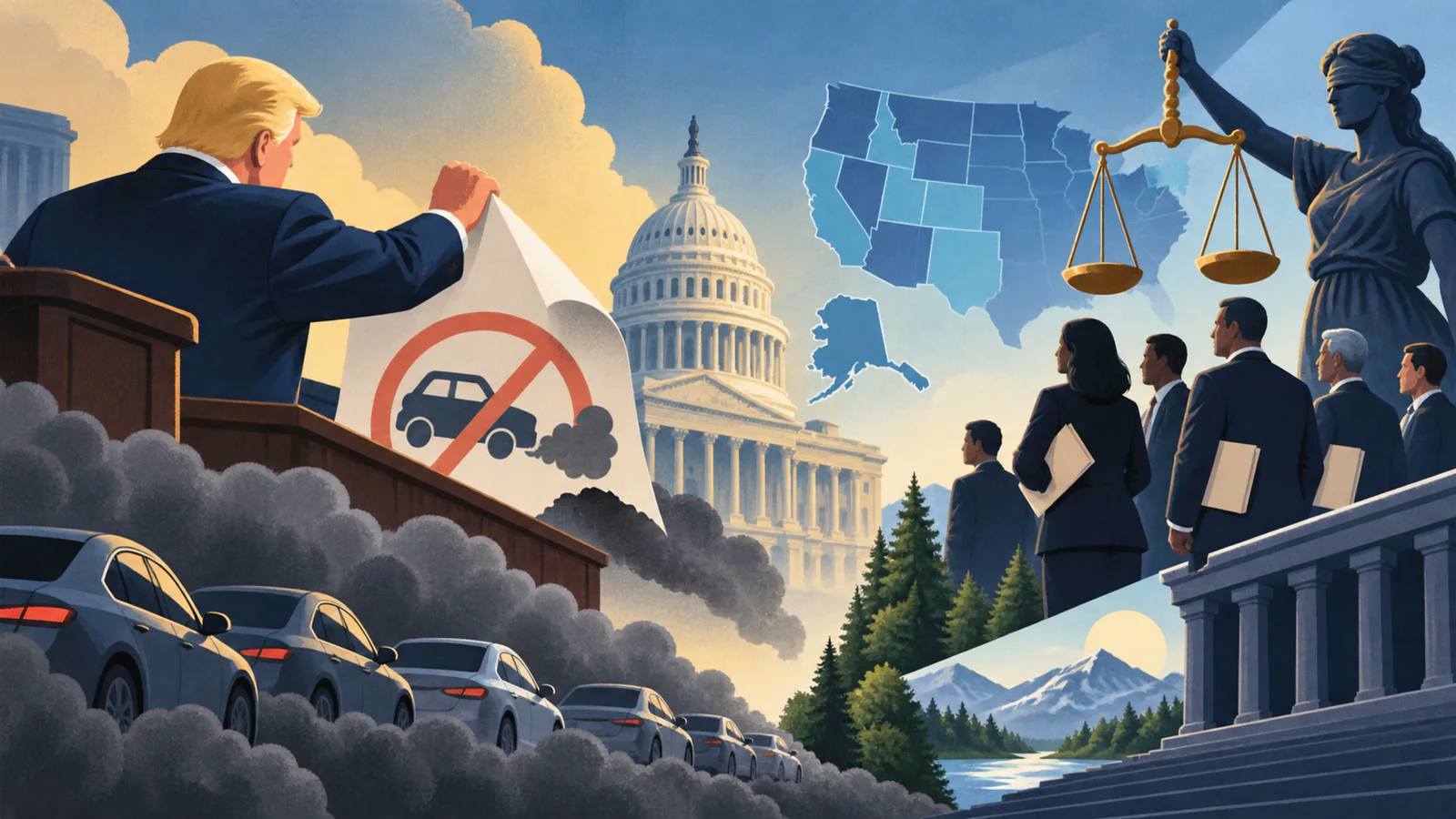
The Trump administration's EPA repealed federal tailpipe greenhouse-gas limits for automakers. California and other states are challenging the action, while manufacturers assess how it changes compliance and product planning.
Further reading and standardsWASHINGTON — In one of the most sweeping regulatory rollbacks in environmental law history, the Environmental Protection Agency (EPA) officially dismantled federal tailpipe emissions limits and electric vehicle manufacturing mandates for U.S. automakers on Thursday. EPA Administrator Lee Zeldin signed the final rule in Washington, declaring that the federal government will formally rescind multi-year greenhouse gas standards established under the Clean Air Act, a decision intended to save Detroit's "Big Three" tens of billions of dollars in compliance penalties but immediately igniting a high-stakes multi-state legal war led by California and fifteen other state attorneys general.
A Major Policy Shift: Scrapping Stringent Tailpipe Caps and EV Targets
The executive action nullifies vehicle emissions rules that would have required over 55% of all new light-duty vehicles sold in the United States to be zero-emission electric models by model year 2032.
Under the revised regulatory doctrine, the EPA determined that the previous administration had overstepped its statutory authority by effectively compelling automakers to transition from internal combustion engines to electric drivetrains without explicit congressional authorization — invoking the Supreme Court's "Major Questions Doctrine." The new framework establishes relaxed fuel efficiency baselines that allow manufacturers to produce traditional gasoline, diesel, and hybrid powertrains indefinitely without incurring heavy federal emissions fines.
"Today, we restore consumer choice, protect American manufacturing jobs, and liberate American families from government-mandated vehicle electrification," Administrator Zeldin stated at a ceremonial signing ceremony flanked by auto industry workers.
Automakers Caught in the Middle: Billions Invested in Battery Plants
While legacy domestic automakers celebrated the removal of immediate financial penalties, the sudden policy reversal creates profound strategic friction for corporate executive suites:
- Sunk Capital Investments: Detroit automakers including General Motors, Ford Motor Co., and Stellantis have already committed more than $120 billion to domestic battery gigafactories, retooling assembly plants across Michigan, Ohio, and Tennessee.
- Global Regulatory Divergence: Because the European Union, China, and Canada retain aggressive zero-emission mandates, American automakers must continue engineering complex multi-platform vehicle architectures for export markets.
- Hybrid Realignment: Corporate planners are rapidly pivoting production capacity toward plug-in hybrid electric vehicles (PHEVs), which satisfy consumer demand for fuel economy without relying exclusively on charging infrastructure.
State Flashpoint: California Leads 16-State Lawsuit to Defend Clean Air Waivers
The repeal triggered immediate legal retaliation from state capitals committed to decarbonization policies.
Within two hours of the EPA announcement, California Attorney General Rob Bonta, joined by a coalition of fifteen states representing more than 40% of the U.S. auto market, filed a petition for review in the U.S. Court of Appeals for the D.C. Circuit. The states contend that the EPA's arbitrary revocation violates the Administrative Procedure Act and unconstitutionally infringes upon California's historic Section 209 Clean Air Act waiver, which grants the state independent legal authority to set stricter vehicular emissions standards.
"No federal agency can erase decades of settled environmental science and state clean air sovereignty with the stroke of a pen," Attorney General Bonta proclaimed. "We will defend our clean car standards in court to the finish."
Market Outlook: A Fractured National Market and Supreme Court Showdown
Automotive industry executives warn that a protracted legal battle threatens to create a "bifurcated national market," forcing manufacturers to build different vehicle configurations for red and blue states:
Legal scholars project that emergency injunction requests will reach the U.S. Supreme Court by late 2026, establishing a definitive constitutional precedent over whether federal environmental preemption overrides state-level clean energy mandates.
Further reading
Use these official collections to explore the subject and confirm time-sensitive figures against the dated record.