
What to know
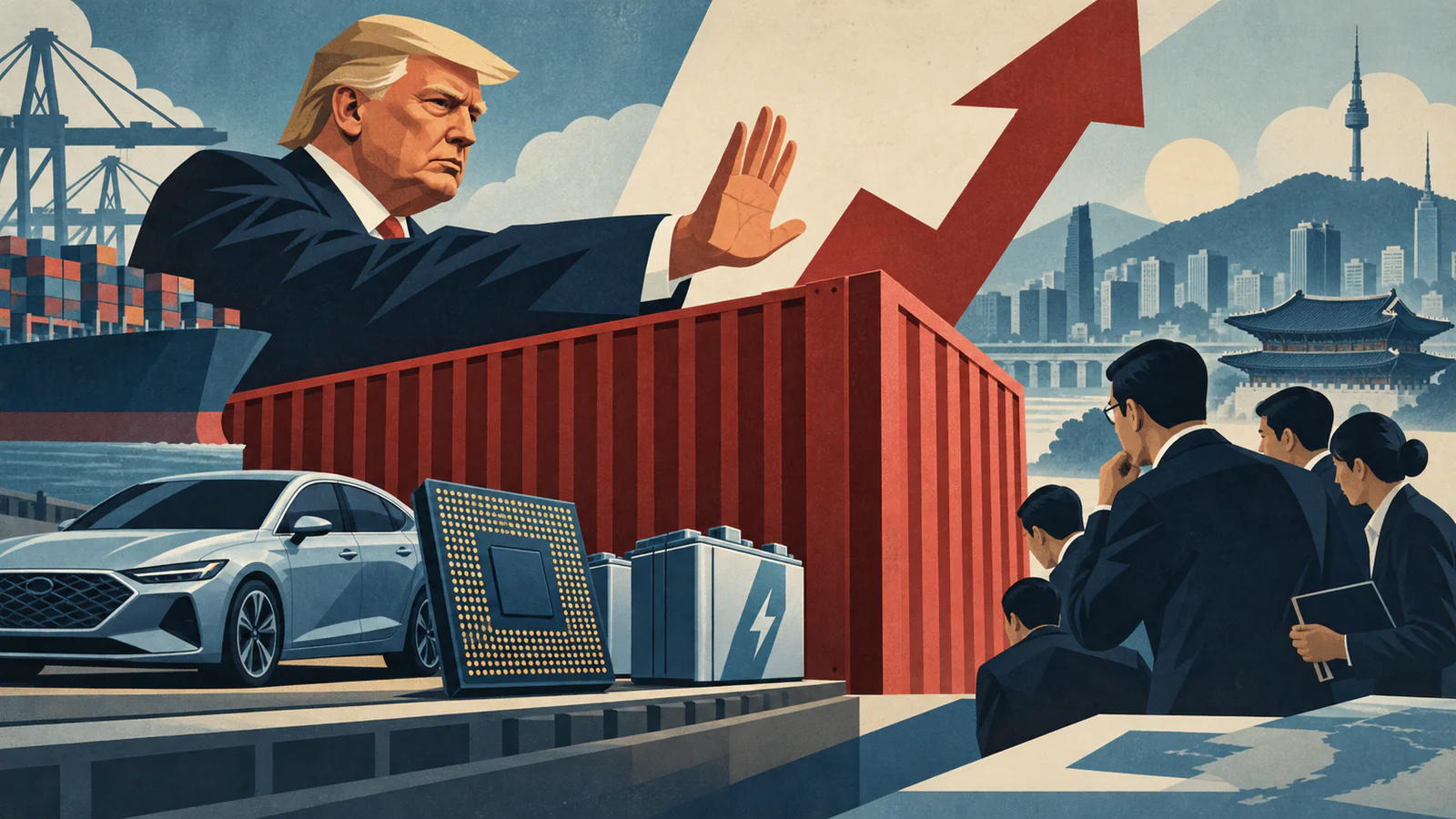
President Donald Trump threatened 25% tariffs on selected South Korean automobiles, semiconductors and industrial goods, giving Seoul 45 days to address trade and defense cost-sharing disputes.
Further reading and standardsWASHINGTON & SEOUL — In a dramatic escalation of international trade policy that threatens to upend vital Pacific supply chains, President Donald Trump formally announced that the United States is preparing to impose 25% retaliatory tariffs on all South Korean imports, targeting automobiles, advanced semiconductors, refined steel, and lithium-ion electric vehicle batteries. Speaking from the White House on Monday, Trump cited chronic bilateral trade deficits, inadequate reciprocal access for American agricultural and automotive exports, and disputes surrounding military defense cost-sharing, delivering an economic shock to America's treaty ally and sparking urgent emergency meetings in Seoul.
What Happened: Threatening a 25% Tariff on a Key Indo-Pacific Ally
The executive announcement targets a trade relationship governed by the United States-Korea Free Trade Agreement (KORUS), which eliminated duties on over 95% of bilateral consumer and industrial goods.
Trump argued that despite previous trade renegotiations, the U.S. merchandise trade deficit with South Korea expanded past $55 billion in 2025, driven by surging American consumer purchases of Hyundai and Kia vehicles, Samsung electronics, and LG energy storage solutions. Asserting authority under Section 232 of the Trade Expansion Act and Section 301 of the Trade Act of 1974, the administration set a strict 45-day deadline for Seoul to eliminate non-tariff barriers, increase purchases of U.S. liquefied natural gas (LNG), and conclude a revised Special Measures Agreement regarding U.S. troop stationing costs.
"South Korea is a great country, but they run massive, unfair trade surpluses against the United States while expecting our military to provide security at below-market rates," Trump told reporters. "Reciprocity is the law of the land. Either we have fair trade, or they will pay a 25% duty on every car and microchip entering our ports."
Seoul's Emergency Response: Trade Delegations and Supply Chain Alliances
The sudden tariff announcement sent shockwaves through South Korea's export-reliant industrial conglomerates:
- Emergency Cabinet Session: South Korean President Yoon Suk Yeol convened an emergency economic national security council in Seoul, dispatching the Minister of Trade to Washington for immediate closed-door negotiations.
- Massive U.S. Investments at Risk: Korean corporate leaders pointed out that conglomerates including Samsung Electronics, Hyundai Motor Group, and SK Hynix have already invested over $110 billion constructing semiconductor fabs and EV battery mega-plants in Texas, Georgia, and Indiana.
- Retaliatory Warning: Trade officials in Seoul warned that unilateral tariff enforcement would violate WTO and KORUS bilateral agreements, indicating that South Korea is preparing reciprocal duties on U.S. aerospace, pharmaceutical, and agricultural exports if talks collapse.
Why It Matters: Automakers, Tech Hardware, and Inflationary Ripples
Global equity markets and supply chain analysts warned of immediate disruptive consequences across North American commerce:
A 25% tariff on Korean automotive imports would immediately add an estimated $4,500 to $6,000 to the sticker price of popular crossover SUVs and electric cars sold in the U.S., driving vehicle inflation higher right as consumers grapple with high auto loan rates. Furthermore, high-bandwidth memory (HBM3e) chips manufactured by SK Hynix — essential components for Nvidia AI accelerators assembled in the U.S. — would see sudden cost inflation, impacting American technological competitiveness.
What to Watch Next: The 45-Day Negotiating Window and Energy Offtakes
Trade economists view the 45-day deadline primarily as high-leverage brinkmanship designed to extract immediate commercial concessions:
Diplomatic insiders anticipate a compromise framework in which South Korea pledges multi-billion-dollar long-term contracts to purchase U.S. Alaskan and Gulf Coast LNG, expands quota access for American beef and apples, and agrees to an elevated financial contribution for the maintenance of 28,500 U.S. armed service personnel stationed on the peninsula.
Further reading
Use these official collections to explore the subject and confirm time-sensitive figures against the dated record.